
Is Dissociative Identity Disorder a Gender Identity?

The short answer is no. However, after a recent Journalist, Dr. Karlyn Borysenko went undercover at a Transforming Gender Conference in Boulder Colorado, a person with dissociative identity disorder did a presentation on why it should be considered a gender identity and not a mental disorder. The link to the presentation is below:
First, I’d like to bring you back to a couple of years ago to May 25, 2019 when the World Health Organization approved a resolution to remove “gender identity disorder” from ICD-11 (The International Classification of Diseases version 11) and created a new chapter dedicated to sexual health. With the publication of the DSM-5 Diagnostic Statistical Manual volume 5) Gender Identity Disorder was eliminated and changed to Gender Dysphoria in 2013. Gender identity disorder was formally known as transsexualism in the DSM-4.
Now as most of you know, I have been diagnosed with gender identity disorder and am a transsexual man. I still fully believe gender identity disorder and/or gender dysphoria is still a mental disorder. However, over the past few years that has changed. Now you must affirm patients with gender dysphoria. You don’t even need to have dysphoria to consider yourself transgender. This was the start of what I believe will be the slow breakdown of considering mental disorders as identity choices or options. Because after all, if your mental illness doesn’t cause you any distress, then why would you need to be diagnosed or treated, right? At least, that’s what was argued by one presenter at this conference.
Now I want to be clear, if anyone is struggling with a mental health condition, please seek professional care. I am a mental health advocate and I fully support getting help from a therapist, psychologist or a psychiatrist. Heck, I’m still personally in therapy to this day and take mental health medication to help the anxiety caused by some of my own mental health conditions. I am not a therapist, and I don’t claim to be. So please remember this as you continue with the article.
Dissociate Identity Disorder formally known as Multiple Personality Disorder is currently a highly complex mental disorder that is caused by many things, including extreme and repetitive childhood physical, emotional or sexual trauma. It has also been referred to as Split Personality Disorder. Per WebMD:
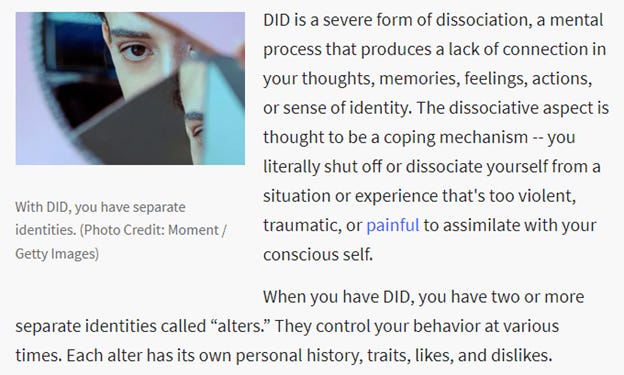
The Diagnostic Statistics Manual Version five, known as the DSM-5 provides the following criteria to diagnose dissociative identity disorder:
Two or more distinct identities or personality states are present, each with its own relatively enduring pattern of perceiving, relating to, and thinking about the environment and self.
Amnesia must occur, defined as gaps in the recall of everyday events, important personal information, and/or traumatic events.
The person must be distressed by the disorder or have trouble functioning in one or more major life areas because of the disorder.
The disturbance is not part of normal cultural or religious practices.
The symptoms cannot be due to the direct physiological effects of a substance (such as blackouts or chaotic behavior during alcohol intoxication) or a general medical condition (such as complex partial seizures).
Now on to my analysis of the presentation.
This presentation was called, TRANSforming Plurality: Being trans and more than one and was presented by Jacob Lester and Ayden Parish. You might think that because I listed two presenters that this was in turn presented by two different people in two different bodies. However, Jacob and Ayden are one person, claiming that six entities reside inside of them and that they have Dissociate Identity Disorder. One of those identities attends the University of Colorado as a PhD student, which is why they were asked to speak at this conference.
In this presentation, they spoke about the idea that Dissociate Identity Disorder should not be considered a disorder but instead a new gender identity called Systemgender, meaning the sum of all genders in the system. They even had a flag created for this new gender identity and showed it during the presentation.
One of the main reasons they discussed to back up this theory was that because, per Jacob/Ayden’s, their disorder does not cause them distress, so why should they be diagnosed or treated through psychiatry? Now let’s break this question down.
If your mental illness doesn’t cause you any distress, then why would you need to be diagnosed or treated, right? I would first argue if your mental illness is not causing you any distress then do you even have the disorder you claim to have? Further in the case of Dissociate Identity Disorder, the side effect of severe childhood trauma or other factors that may have contributed to your disorder, is dissociating into multiple different personalities. So, isn’t the fact that Jacob/Ayden has six different entities living in their body proof of their distress? Even though Jacob/Ayden seems to think that they are not experiencing distress, because all six entities get along in their head, I believe they are still experiencing distress. The early trauma they endured caused them extreme distress which in turn caused them to dissociate into multiple personalities. So, despite all the entities getting along according to them, the initial distress of the trauma they endured is what caused them to have Dissociate Identity Disorder. Jacob/Ayden further made arguments against Psychiatry, using their own personal experience with their attempts to get what they considered as proper treatment for their disorder, as well as undergoing medical transition for being transgender, as one of their entities considers themselves transgender. They even advised others in the audience who have dissociate identity disorder to deceive their therapist and not advise their therapist that they have the disorder until after they transition. Since this is exactly what Jacob/Ayden did with their own therapist, as they explained they did not tell their therapist they had dissociate identity disorder until five years after they underwent medical transition, including surgery. They explained the reason behind this is because if they were to be honest with their therapist about their disorder that the therapist may be hesitant to write a letter for transgender surgeries and care. A person with a mental disorder not getting treatment should not be giving advice on that mental disorder. This was one of the scariest parts of this presentation.
In my opinion, you should never lie to your therapist regarding any disorders you may have. You need to be honest with your therapist and doctors for them to provide the correct care for the issues and possible disorders you are facing. If you feel the need to try to deceive your therapist just to be able to transition, then that’s a problem. You need to work through your other issues and trauma prior to medical transition. This is why I spent six years in therapy before deciding to transition. Medical transition is not something that should be taken lightly and should be the last line in trying to work through and alleviate gender dysphoria. It is a life altering decision and should be treated as such.
Some people make think the possibility of Dissociate Identity Disorder becoming a gender identity instead of a mental illness is farfetched. However, if you believe this, I encourage you to remember what happened with the diagnoses of gender dysphoria over the past few years. If you don’t think this could happen, it absolutely can.
The normalization of gender dysphoria was the start of what I believe will be the slow breakdown of considering mental disorders as identity choices or options. This presentation was further proof of that theory.
We need to start pushing back on these ideas and influences in order to have a productive stable society.
Again, a special thank you to Dr. Karlyn Borysenko for breaking this story and for her continuous work in exposing what is being taught in schools, colleges and universities including training for teachers and therapists. Karlyn’s work is extremely valuable in learning what the far-left Socialists are up to and how to fight back. If you can support her journalism and work, please do so. The link to her substack is below.